Nos contenus

Climat, énergie et mobilité

Blog posts

Publications

avril 2025

Global Labs: Food Systems Transformation

As the 21st century unfolds, the world’s food systems stand at a critical juncture. What we eat, how it’s grown, and how it reaches our plates have implications beyond personal health— they shape livelihoods, ecosystems, and the planet’s future. To make sense of this complexity, 25 authors co-created five radical visions for the future of Food Systems in this Policy Brief. The basis of their chapters was a workshop that was implemented in March 2025 on the same topic as this Policy Brief. The event and subsequent publication of results are part of foraus’ Global Labs series, which aims to connect students from Geneva and beyond with the International Geneva ecosystem, to foster innovative policy ideas. Through an exchange with professionals and by co-writing a policy brief, each Global Lab strives to strengthen students’ set of hard skills (e.g. policy writing), soft skills (e.g. public speaking), and personal networks, while providing key multilateral fora with youth’s inputs.

Authors: Nazanin Asbaghipour, Ebrima Barrow, Ruth Bandomah, Ana Chamon, Triana Gil, Mariana Hervigo, Giulia Azzarello, Jean-Pierre Desarzens, Suban Biixi, Romberg Gondim, Mitsuki Ishii, Rebecca Kübler, Margaux Serratore, Kuei-Jr Liao, Antonia Massocco, Anna-Kristiina Pae, Pilar Alejandra Paradiso, Angelina Pavlenko, Andrea Peroziello, Ankita Sharma, Yuhui Song, Shilpa Ann Thomas, Yating Wang, Carolyn Wu

TéLéCHARGER LE DOCUMENT

Partager

décembre 2019

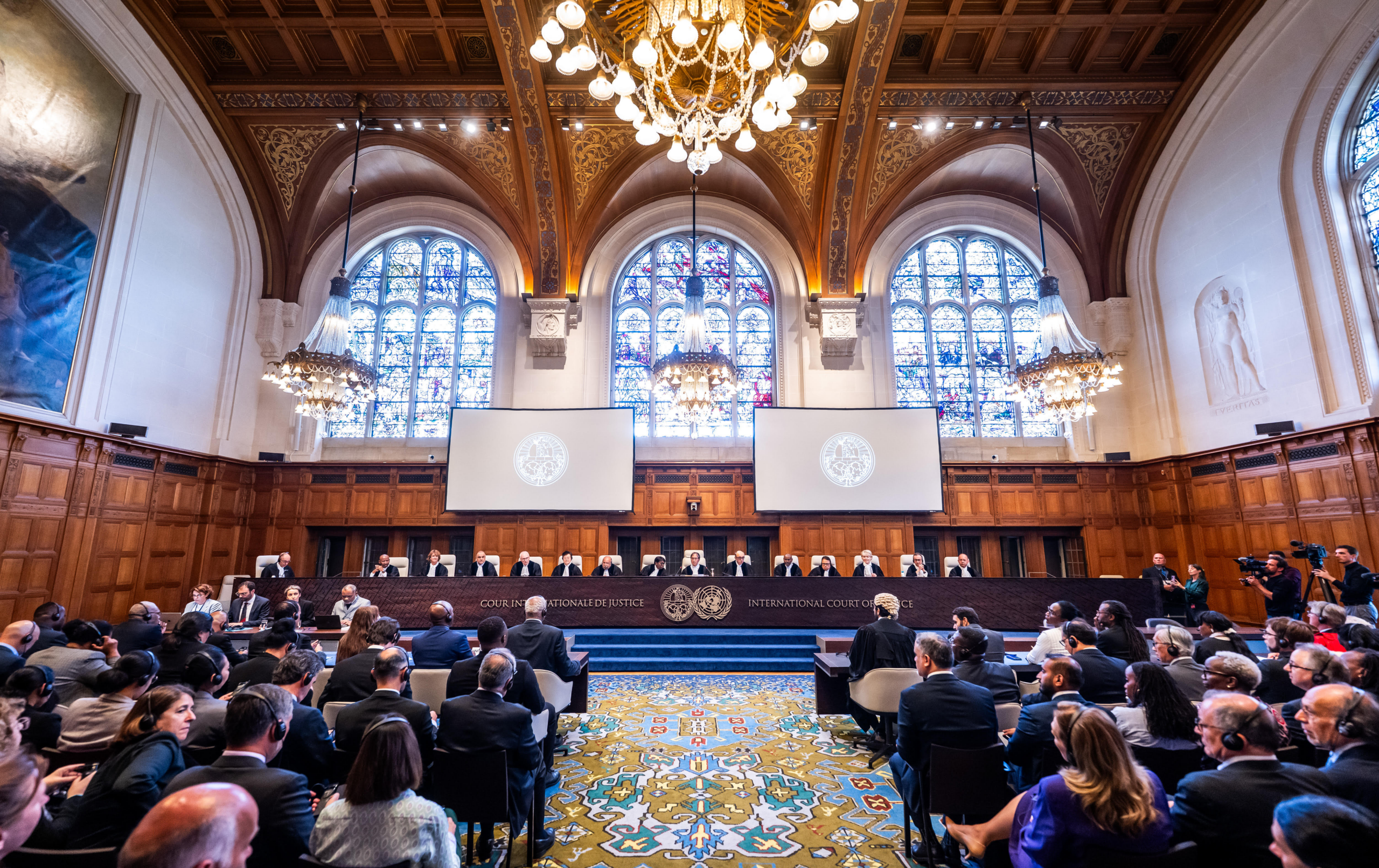
Protecting the Environment in Court: A case for the reinforcement of environmental rule of law

Over the past decades, global environmental governance has significantly developed and now includes a large number of international agreements, mechanisms and institutions. However, as 2019’s climate strikes and demonstrations have highlighted, no significant improvement has been achieved. In order to achieve long-term and profound progress in environmental governance, policy focus needs to be complemented by intensified efforts to strengthen environmental rule of law. To do so, the capacity of international courts to pronounce judgements on environmental matters, the clarity and scope of environmental legal principles, and compliance with and implementation of judgements must be further strengthened. This policy brief outlines concrete steps which justice and foreign ministries can take, both nationally and internationally, in order to strengthen environmental rule of law.

TéLéCHARGER LE DOCUMENT

Partager

novembre 2019

Grassroots ideas to halt biodiversity loss

Biodiversity is in a desolate state. In their first report released in May 2019, the Intergovernmental Science-Policy Platform on Biodiversity and Ecosystem Services (IPBES) finds that biodiversity is declining at rates faster than at any time in human history, threatening ecosystem functions critical to human survival and wellbeing. While the report is novel in terms of its scope and multilateral backing, the overall trends were long known, yet largely outside of the awareness of society. That’s why, in autumn 2018, foraus set out to crowdsource innovative ideas on how to tackle the biodiversity crisis through a newly developed online policy innovation tool: Policy Kitchen. Together with experts, foraus defined three challenges with a link to foreign policy, in which action is particularly needed: How to square biodiversity conservation and economic development? How to make trade more biodiversity-friendly? And how to improve global governance around biodiversity conservation? foraus discussed these questions with over 100 participants from various backgrounds. The process resulted in 43 ideas on biodiversity conservation, four of which were developed further and are presented in this publication.

TéLéCHARGER LE DOCUMENT

Partager

novembre 2017

Neue Wege in der Schweizer Klimapolitik

Die Schweiz war 2015 für einen Treibhausgas-Ausstoss von 48.1 Mio Tonnen CO2-Äquivalenten (CO2eq) verantwortlich. Die Emissionen sollen gegenüber 1990 mittels verschiedener Massnahmen um 50% gesenkt werden. Die Schweiz wird deshalb oft als Vorreiterin im Klimaschutz bezeichnet und ist Mitglied der «Paris High Ambition Coalition». Umfassende Klimaziele sind komplex. Darum schlagen die Autor*innen vor, die Forschungs- und Innovationsstärke der Schweiz zu nutzen, um Klimadaten besser zugänglich zu machen. Durch die Gründung eines Swiss Open Climate Data Centers stünden sowohl für Forschung als auch Unternehmen mehr Daten im Klimabereich zu Verfügung. Damit unterstützt die Schweiz einerseits eine wissenschaftsbasierte Klimapolitik. Andererseits ermöglicht der Zugang zu Daten die Entwicklung neuer Technologien und Dienstleistungen und stellt damit einen wichtigen Standortfaktor dar für Unternehmen, welche aus innovativen Lösungen tatsächliche  Anwendungen entwickeln. Durch gezielte Förderung von Open Data Projekten, bspw. als Kriterium bei Nationalfonds-Projekten, kann die Schweiz den Datenzugang zusätzlich antreiben.


TéLéCHARGER LE DOCUMENT

Partager

août 2016

Kohärente Umweltpolitik für eine globalisierte Schweiz

Die Menschheit lebt ökologisch auf zu grossem Fuss. Sie beansprucht 1.6 Mal mehr natürliche Ressourcen, als die Erde regenerieren kann. Die Schweiz trägt viel dazu bei: Würden alle Menschen so leben wie wir, wären drei Planeten nötig. Dabei fallen mittlerweile fast drei Viertel unserer Umweltbelastung im Ausland an. Sie steckt in importierten Produkten und Gütern, die wir konsumieren. Inhaltlich muss die Schweiz sodann national und international wirksame Massnahmen ergreifen. Im Inland besteht Nachholbedarf, vor allem in den Bereichen Klimaschutz, Biodiversität sowie nachhaltiger Konsum und Produktion. Der steigenden Umweltbelastung, die im Ausland durch unseren Konsum verursacht wird, sollte die Schweiz auch mit aussenwirksamen Strategien entgegentreten. Dieses Papier präsentiert fünf Hebel, mit denen die Schweiz ausserhalb ihrer Grenzen auf eine ressourcenschonende Wirtschaft hinwirken kann und zeigt konkrete Handlungsempfehlungen auf.

TéLéCHARGER LE DOCUMENT

Partager

Projets

Politique en scène : décider de l’avenir

foraus et Proberaum Zukunft mettent en scène ensemble les défis futurs de la politique étrangère suisse dans un cadre unique. Après une première édition couronnée de succès à Berne (printemps 2025), la prochaine édition se tiendra à l’automne 2026 à l’hôtel de ville de Bâle.

Les avenirs du nucléaire – Repenser la sécurité nucléaire pour un avenir meilleur

En 2024, une équipe de quatre membres de foraus, sélectionné·es dans le cadre du programme Next Generation Foresight Practitioners (NGFP), a lancé le projet « Kaleidoscope of Nuclear Futures » (Kaléidoscope des futurs nucléaires).
Cette initiative menée par des jeunes vise à explorer comment les sociétés pourraient gouverner, innover et vivre avec les technologies nucléaires dans les décennies à venir.

EU citizens in Switzerland: your voice, your opinion!

Grâce à ce projet, nous donnons aux citoyen·ne·s étranger·es vivant en Suisse, et aux citoyen·ne·s de l’UE en particulier, une voix et un rôle actif dans le débat public sur le climat, la migration et la politique numérique, en favorisant un dialogue constructif sur l’avenir commun entre la Suisse et l’UE dans ces domaines politiques.

Personnes

Policy Fellow

Andreas Oeschger

Policy Fellow

Sébastien Chahidi

Comité du lecture et Policy Fellow

Oskar Jönsson

Policy Fellow

Anna Stünzi